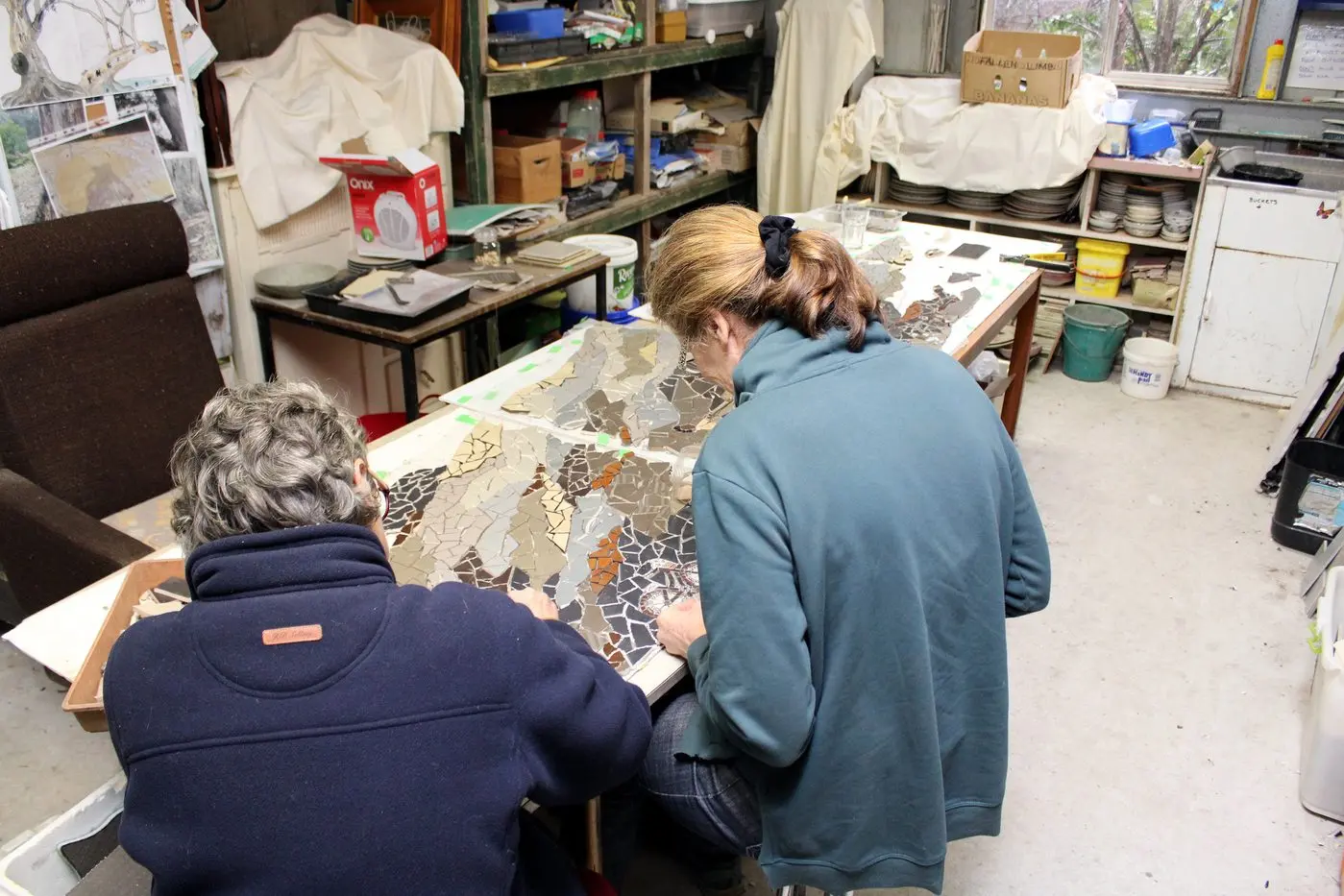
TILE by tiny tile, Myrtleford’s ‘Tree of Life’ is growing, much like the confidence of the two women who are painstakingly nurturing it.

The much anticipated, 21-square metre interactive mosaic of a river red gum that's to be installed on the barbeque shelter in Jubilee Park is an ambitious Crackpots project.

Although their identity may just be Myrtleford’s most open secret, the Crackpots – or ‘CP1’ and ‘CP2’ – chose the name because they prefer the mystique of anonymity, yet love hearing those not in the know say ‘who are the Crackpots?’.

Laid out in a corrugated iron shed on a property out of town, the project has been running on and off for almost 18 months.

The Crackpots secured the initial funding from Regional Arts Victoria, and later were given an extension of time and additional funding after the final location of their installation changed.

“We’re in the home straight,” said CP1.

“We are much closer with the mosaic and very confident of having it installed by the end of the year when its due to be completed."

The project has been a huge learning experience.

"While it’s a major artistic endeavour, we’ve also learnt so much about the technical side of mounting a big installation on a wall," said CP1.

“We understand much more about the engineering of the frame and the substrata involved, and what materials will be used for that.”

Because the Tree of Life is not being placed on a brick wall but on a frame, the Crackpots have sought the expert advice of a leading mosaic artist, Helen Bodycomb, as well as from Nate Rinaldi of Myrtleford engineering firm, Rinlatech.

The Crackpots are now awaiting the outcome of a Alpine Shire Community Grant application to cover the cost of the subframe structure.

During forced breaks in the Tree of Life project, the pair completed their ‘lockdown project’, a three-metre square, ground level mosaic of the board game Snakes and Ladders located in Myrtleford’s Jubilee Park.

They’ve also been kept busy with commissions for their mosaics from local businesses, as well as adding to their ongoing labour of love, the Myrtleford Mosaic Trail, which now boasts almost 100 small-scale works scattered around the town.

The Tree of Life was never to be merely a static tourist attraction: something for visitors to Myrtleford to see during a stopover at the park or if they went there for a barbeque.

“Ok, it’s a gum tree, but we wanted to make it very Myrtleford by including the things locals and visitors told us they love about the town – wine, cycling, fishing, dog walking…” CP2 said.

“There will be about 30 mini mosaics incorporated into the tree to give it an element of surprise – a treasure hunt, if you like.

“From a distance it will look like a big tree, so people will have to get up close and study it to find them.”

The pair are grateful to the chamber of commerce for believing in them and their vision.

“It began with just a seed of an idea, but they could see its potential to be something unique for Myrtleford and they backed us,” CP1 said.

Creating a 21-square metre mosaic starts with an actual-size drawing of the work, which was produced in a pavilion at the showground.

A sheet of plastic is laid over it and the drawing is then traced with a marker pen to create a more durable template.

As the work is being done in sections, the pair constantly return to the full-size drawing to ensure the finished work will be seamless when all the sections are finally laid end to end and filled in.

Local op shops are tile treasure troves, although the women love to include broken plates other recycled ceramic materials.

Do they now see themselves as professional artists?

“By the time this is up I think we’ll be able to say we are,” CP1 said.

“For now, let’s say we are emerging artists.

“But, it’s very exciting that we are actually being paid!”