PHOTO
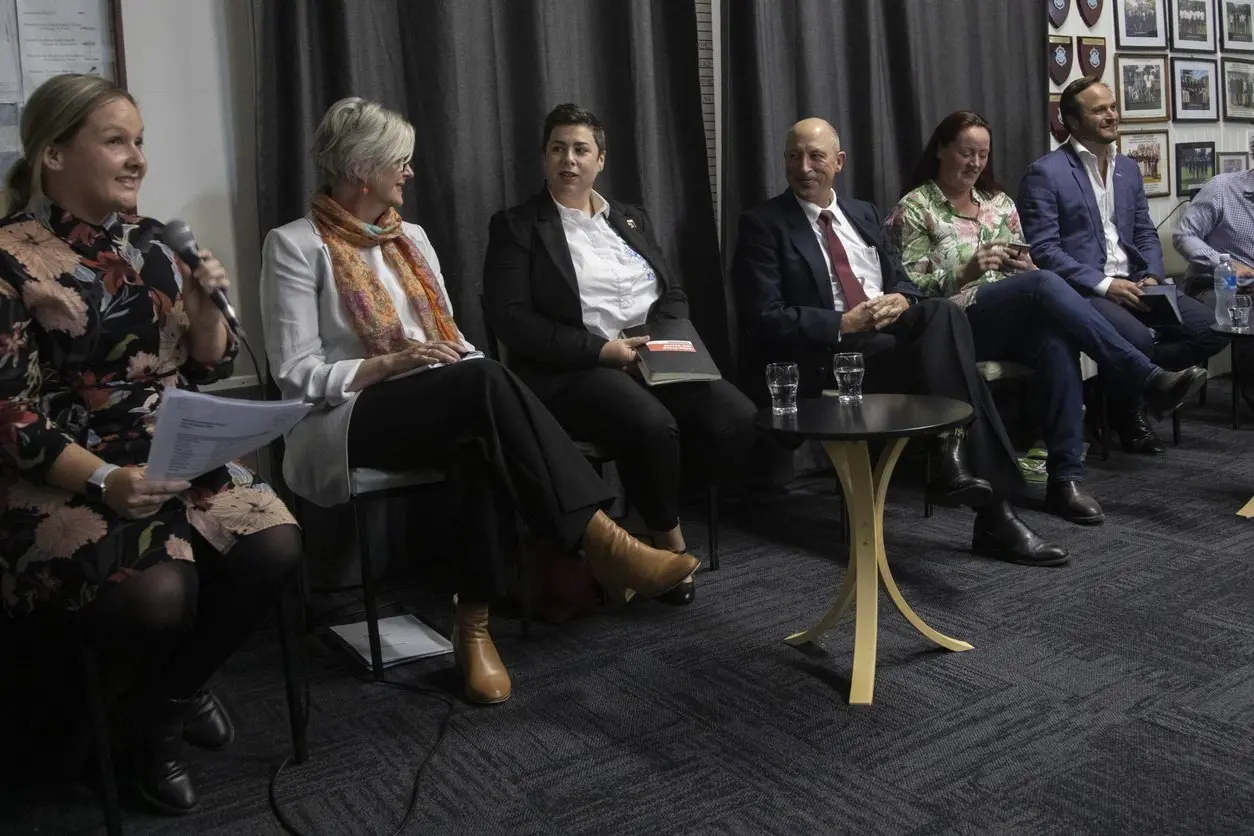
CANDIDATES for the federal electorate of Indi discussed the most pressing matters of the region at a 'Meet the Candidates' forum in Euroa last Wednesday night.
Six of the 10 candidates were part of the panel discussion including incumbent Helen Haines (Independent), Nadia David (Labor), Julian Fidge (Liberal Democrats), Liz Fisher (Nationals), Ross Lyman (Liberal) and Benjamin Gilbert (Greens).
Candidates Angel Aleksov (Animal Justice Party), Lachlan O'Connell (Derryn Hinch's Justice Party), Stephen Williams (United Australia Party) and Beth Stevens (Pauline Hanson's One Nation) were all apologies.
Each candidate was given two minutes to discuss matters selected by the local community as the most significant topics of the region.
The topics chosen were integrity and corruption, rural economic development and climate change.
INTEGRITY AND CORRUPTION
The first question posed to the candidates was about integrity and corruption, asking: "Where did you receive your election funding from and what methods will you implement to ensure that integrity and accountability is upheld in federal politics?"
Yackandandah–based Greens candidate Benjamin Gilbert was the first to answer the question, discussing the Greens' history of calling for integrity within politics.
"I recently spent more money on my partner's bicycle than my entire campaign budget," he said.
"The Greens do not accept any dirty money.
"We do not receive funding from the coal industry or the tobacco industry.
"In 2010 the Greens introduced legislation into the senate for a federal integrity commission."
Wangaratta–based Independent incumbent Helen Haines followed Mr Gilbert and detailed the work she has already done against corruption while the local member.
"In every state and territory across Australia we have an anti–corruption or an integrity commission," she said.
"I introduced legislation into parliament to establish a robust federal integrity commission that was fit for purpose.
"When it comes to political donations, I introduced private members legislation into the house about this because I fundamentally think that we need better transparency.
"I live by that myself, every donation over $1000 I declare on my website every quarter and every donation over the AEC limit I declare on my website within five days."
Beechworth–based Labor candidate Nadia David was the next speaker on the matter, providing information on the plans her party has already made if elected.
"Labor is the only party going into this election with an iron clad guarantee that there will be anti–corruption commission by Christmas," she said.
"It will be fully independent of government and fully funded.
"Most of my political donations have come from unions.
"The first thing I think we need to do is get rid of political donations altogether and establish a fund so every single candidate gets the same amount of money to campaign with."
Wangaratta–based Liberal Democrats' candidate Julian Fidge spoke about how his party receives funding.
"I don't receive any campaign funding I just pay for it myself," he said.
"The Liberal Democrats receive funding from membership and I don't think that they have any significant big party donors.
"In terms of corruption, we support the commissions but we are very strong on personal freedoms and would not support any kangaroo court closed hearing type things."
Browns Plains–based Nationals' candidate Liz Fisher explained how her personal experiences shaped the way she views integrity.
"Regarding integrity, it's an interesting thing, one thing I do know is that I am extraordinarily honest," she said.
"We do have a lot of systems and processes in place and Australia is one of the least corrupt places in the world.
"It's not going to stop illegal behaviour and with public hearings I don't want a witch hunt.
"All donations that have been made to my campaign are fully compliant with all laws."
Wahgunyah–based Liberal candidate Ross Lyman reflected on his military service while answering the question.
"We were told to act with integrity maybe more so than most professions in Australia," he said.
"We have a judicial system that is able to deal with these matters.
"At the moment you're innocent until proven guilty and I wouldn't want to see that reversed.
"We started the campaign back in January and have had dozens of donors, grassroots people in the community and businesses and holding fundraisers."
RURAL ECONOMIC DEVELOPMENT
The question asked to the candidates was: "What policies and approaches are you going to implement to support businesses in the region to address staff shortages as well as embracing the digital economy and the growing tourism opportunities in the region?"
Ms David discussed the employment issues in the region.
"As a member of the Labor Party my first answer is going to be pay people more," she said.
"The whole community benefits from good wages."
Dr Fidge spoke about the policies of the Liberal Democrats that he says will benefit Indi.
"We propose less taxation and would increase the tax–free threshold to $40,000," he said.
"This will encourage people to enter the workforce.
"We would like to have a flat tax rate so we don't punish people who work long hours or overtime."
Ms Fisher discussed the capacity for the region to improve its tourism numbers.
"A huge issue is finding workers and finding somewhere for them to live," she said.
"There is an underinvestment in quality tourism accommodation.
"We need to look at funding opportunities for tourism infrastructure and tourism product to reduce the pressure on housing."
Mr Lyman spoke on roadblocks that were preventing staff returning to work.
"Let's stop the mandates and get people back to work that are otherwise kept out of jobs," he said.
"We need to bring international workers back in.
"There are opportunities for Euroa to be a satellite hub for Melbourne if we get the manufacturing and infrastructure right."
Mr Gilbert explained that the region had the right idea but had been overlooked by government.
"The strategic plan from the council is extremely progressive, it just needs to be supported," he said.
"You've got the answers, you just need the support to achieve it.
"Unfortunately, you've been hard done by from your representatives for the last 20 years."
Dr Haines spoke about shortages across Indi.
"There is a workers shortage right across Indi," she said.
"It doesn't matter if you're looking for drivers for your trucks, hospitality workers, health workers or tradies.
"We need to unlock housing so that workers wishing to live here are able to do so."
CLIMATE CHANGE
The question posed to the candidates regarding climate change was: "What innovative plans and policies will you implement across Indi to keep us in line with 1.5 degrees, maintaining economic growth and supporting other regions as well to reduce their emissions?"
Ms Fisher spoke about the capacity to advance the technology in the region.
"There was a time where PV solar panels were novel," she said.
"Obviously technology has the answer.
"The federal government is still investing and has grant programs to encourage more innovation in technology."
Mr Lyman agreed that technology was the best way to tackle climate change.
"We are investing in hydrogen, we have a $40 million investment in Wodonga that aims to provide 10 per cent of their gas needs," he said.
"Base load power is another area that we are investing in.
"Let's get there but keep it in in–line with the rest of the economy, there are other aspects that we need to factor in."
Mr Gilbert disagreed with the Liberal plan to tackle climate change.
"I wish it was true that the hydrogen gas project in Wodonga was anything other than a prop for the existing gas infrastructure that will be a stranded asset in the near future," he said.
"Electrify everything on our grid, get rid of coal and gas as soon as possible.
"Base load power is a crock."
Dr Haines discussed the resources the country had to fight climate change.
"We know that we have the world's best resources when it comes to solar and wind," she said.
"What we need to make sure of is that we truly benefit from this prosperity.
"Our nation is a place where we can be a world leader in renewable energy generation."
Ms David discussed Labor's plans and its similarities to the Greens.
"It's the plan that works," she said.
"We know that we need to electrify the nation.
"Labor has proposed a $20 billion fund to rewire the nation and what we want to do is ensure that all of the regional solar, wind and hydro generation is going to be in the regions."
Dr Fidge introduced a more controversial opinion on how to handle the climate situation.
"We would like to lift the prohibition on nuclear energy," he said.
"The reason we'd like to use nuclear energy is because it's the cheapest, the safest and easiest to implement.
"It's only fear mongering that stops them from being used in Australia.
"Solar will not work, there is no sun at night."