PHOTO
JULY 2022 marks the 80th anniversary of the arrival of Italian prisoners of war at Myrtleford Camp 5, Whorouly East – one of 20 locations in the six states of Australia during World War 2.
To establish Camp 5, the land was compulsorily acquired under the Commonwealth Lands Acquisition Act from Garrett J Roach and Enoch Phillips, on the southern side of what was then known as "Wangaratta Road" (the Snow Road of today).
On April 12, 1942, Garrett Roach wrote to Gippsland & Northern, his stock and station agents: "I intend to take 250 sheep to your next sale.....they are fine wooled sheep.....the government has taken some of my land".
Smaller parcels of land were then acquired from the estate of WJ Williamson and Michael Connor in September 1942.
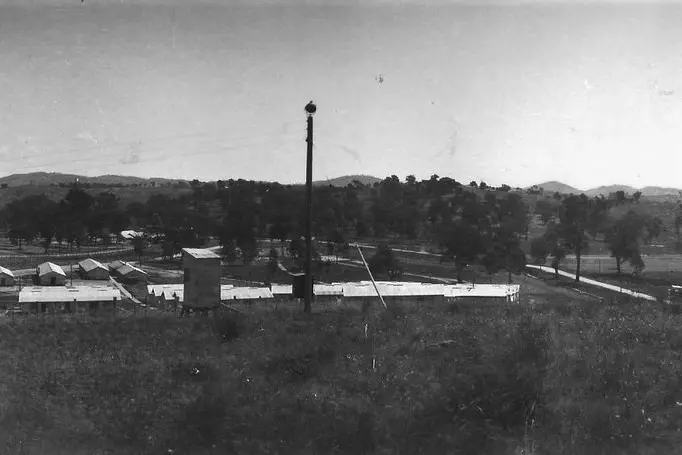
Huts to accommodate prisoners and the supervising 51st Australian Garrison Company were constructed of timber and corrugated iron during the first year.
Prisoners were initially housed in four–man tents.
In the district, community reaction to the camp was muted; concerns about the compulsory acquisitions and security were expressed.
In response to censorship regulations, pages of the "Myrtleford Times" did not refer to Camp 5 in 1942; local wartime news topics centred on appeals for aluminium, instructions on making camouflage netting, shortages of newsprint, electricity, tea and superphosphate and the activities of the volunteer defence corps and aircraft spotters.
Most of the 18,164 Italians imprisoned in Australia had been captured during the North African Campaign in 1941, and many had arrived via India.
Another 268 had been captured as merchant seamen after Il Duce, Benito Mussolini, declared war on the allied forces on June 10, 1940.
Camp 5 was one of six camps in Victoria housing Italian POWs or civilians declared "enemy aliens".
Other camps existed at Tatura, Murchison and Rushworth, where German POWs and interned civilians of Italian, Japanese and German descent were confined.
Murchison Camp 13 accommodated up to 4000 Italian POWs.
Other vital locations housing Italians were Hay and Cowra (NSW) and Loveday (SA).
Myrtleford Camp 5 inmates were army officers, accompanied by their attendants ("batmen") and some merchant seamen.
Arrivals at Whorouly East occurred regularly from Murchison and interstate, alighting at the Gapsted Railway Station and marching downhill to the camp.
A dedicated power line from Beechworth and water supply pumped from Rocky Pont Bridge served facilities, including a hospital, recreation hall and chapel, canteen, extensive sports fields and gardens.
Camp food supplies came by truck and train, supplemented eventually by providing eggs, milk, meat and poultry from local farms.
Medical and dental services, opportunities to study music, drama and language and to play various sports were available on site.
Roll checks were conducted three times daily.
During 1943, opportunities to leave the camp were restricted to "parole marches" under guard or to working parties collecting firewood, clearing land and maintaining roads.
On Wangaratta Road, school pupils at Whorouly East often greeted marchers who anticipated Red Cross sweets would be thrown to them.
Prisoners were always visible in their burgundy–dyed ex–army uniforms.
Escape attempts were infrequent and short–lived.
Two escapes in September 1944, then another from a parole march in November, were followed by time in detention.
Daily newspapers available in the camp were censored to deter thoughts of escape.
Insubordination to an Italian officer and breach of camp regulations attracted frequent punishment.
Supervision was provided by the 51st Garrison, who were mainly veterans of World War 1, ex–British or Indian Army and Navy personnel, or those who had recovered from illness contracted serving in the AIF in North Africa or south–west Pacific in World War 2.
Initially, over 280 were posted on garrison duties, but by early 1944 labour shortages had reduced this to 185.
Camp Commandant Lt. Col. CJ Chisholm, a career soldier, was known for his concern for the wellbeing of all camp residents.
Division and rivalry grew within Camp 5 in 1943.
Benito Mussolini's downfall in July, followed by his rescue by the Germans in September, led to bad feelings between fascists and army officers who supported the decision of King Victor Emmanuel III's government to declare war on Germany.
As a result, in June 1943, two separate compounds – Compound 'A' for fascists (440 officers and other ranks) and Compound 'B' for royalists (254 officers and other ranks) – existed behind the wire.
By this time, the impact of further imprisonment was taking its toll, as evidenced by two young lieutenants in Compound 'A': "It is the barbed wire disease from which everybody is suffering.....there is a continuous relentless struggle of the nervous system against the fence".
An opportunity to be recorded for posterity occurred on November 5–7, 1943, when an Army photographer captured many aspects of camp life, including named formal groups of 578 Italian officers and other ranks and the 51st Garrison at work.
Today, these images provide valuable insights for relatives and friends of prisoners and service members.
As 1943 progressed, changes were underway to address the increasing shortage of human resources in agriculture.
One possible way to address this was to harness labour from the prisoner of war population.
Many Camp 5 Italians responded, becoming "Land Soldiers", enjoying the freedom and social interaction it offered.
Ahead laid a more purposeful life and an eventual return home to Italy.
Acknowledgement: Images from the Australian War Memorial Collection of the Myrtleford & District Historical Society Inc.