PHOTO
By JOHN TAYLOR OAM, Myrtleford and District Historical Society Inc.
MYRTLEFORD’S A D Lowerson VC Memorial Square acknowledges the service to country of local men and women over the past 110 years.
A total of 116 World War I enlistments and 28 ‘In Memoriam’ were recorded on the original memorial dedicated on ANZAC Day in 1923.
Those commemorated all have a personal story and just three family names are recalled here to acknowledge service given in the second decade of the 20th century.
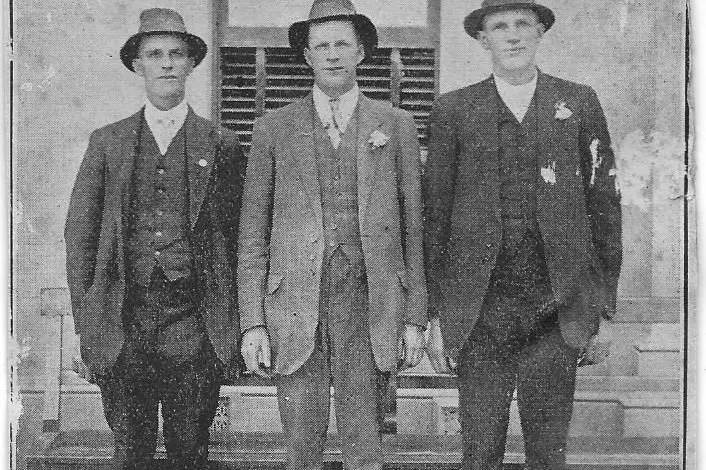
The Sanderson Brothers
On March 14, 1916, the three Sanderson brothers enlisted in the army at Wangaratta.
William Henry (‘Bill’), aged almost 34 and at 6 feet 51/2 inches was the tallest, James Francis (‘Jim’) almost 29 and John Edward (‘Jack’), almost 22 years.
All embarked on the ‘Persic’ for Plymouth, England on June 3, 1916, in the 37th Battalion and then proceeded to France in November.
The Sandersons were three of ten children, born to Sophia and William Sanderson of Buffalo River.
Tragically, they had lost their mother, aged 51 in 1910, from double pneumonia after she had nursed all her children through a measles epidemic.
Bill received a severe gunshot wound in the leg on June 25, 1917, and was transferred to Bethnal Green Military Hospital, London.
He returned home in April 1918.
Jim was hospitalised with influenza and mumps and later bronchitis, and suffered extensive wounds in February, 1917.
Later returning to his battalion, he was reported missing in action in Belgium on October 12, 1917.
A subsequent Court of Enquiry reported Jim was killed in action and official confirmation was finally forwarded to his father on May 11, 1918.
Jim’s campaign medals arrived home in 1923, one year after his brother’s.
Jack too contracted the mumps in France in February 1917 and after leave transferred to the 38th Battalion and then a posting to brigade HQ as a transport driver.
He returned to Australia on the ‘Rio Pardo’ in May 1919.
Both Bill and Jack Sanderson’s return saw them again indulge in community life and a range of farm work in Buffalo River.
Clarence Teakel
Private Clarrie Teakel, born at Bright to Charles and Elizabeth Teakel in 1896, enlisted at West Maitland, NSW on September 11, 1915, where he was employed by the NSW Tramways Department.
He embarked on the ‘Orsova’ on March 11, 1916, and was assigned to the fourth reinforcements of the 30th Battalion.
In England, he was posted to his battalion at Weymouth.
In September 1916 the British Medical Board decided that Clarrie not serve in Europe, but be confined to ‘Home Service’ as he was diagnosed with dermatitis.
During October and November he appeared before a Court Marshall at Penham Downs for using a falsified leave pass and received 59 days confinement with equivalent loss of pay.
Throughout 1917, Clarrie was frequently receiving hospital treatment for his worsening skin condition and during May 1918 a sister and brother wrote on behalf of the family enquiring about Clarrie’s whereabouts and state of health.
They were advised that a response could only be given to ‘next of kin’, Mr C Teakel.
Clarrie died of ‘illness’ on October 2, 1918, five weeks before Armistice Day.
At the time he was a patient at ‘Harefield House’, No 1 Australian Auxiliary Hospital, suffering from dermatitis and bronchial pneumonia.
He was buried at Harefield, UK on October 7 in the St Mary The Virgin Church Yard, his funeral conducted by a Methodist chaplain with support of seven medical staff, a firing party and bugler.
His tablet in the cemetery reads:
‘2464 C Teakel, 30th Bn Australian Infantry, 2nd October, 1918. Age 23. MY DEAR BOY’.
In a parcel dated April 29, 1919 Clarence Teakel’s personal effects were returned to his parents in Myrtleford: shaving gear, wallet and photos and post cards from home.
Then, a photograph of his grave arrived on May 3.
In 1922, Clarrie’s father received his full set of medals and messages from the King.
Henry Norman Rothery
Private Henry Norman Rothery, was born at Hurdle Flat and at the time of his enlistment at 19 years and 10 months he was employed as a clerk at Merino in the Western District of Victoria.
He enlisted at Birregurra on March 3,1915 and named his father Joseph as next of kin.
‘Norman’ (as he was known) had lived at Myrtleford and Beechworth in the North East, where his parents were prominent citizens.
He embarked for Egypt on May 5, 1915, on the ‘Euripides’, a member of the 24th Infantry Battalion, D Company, and after training proceeded to the Gallipoli Peninsula as a member of the Mediterranean Expeditionary Force on August 30, 1915.
On December 1, 1915, Henry’s captain reported him as ‘missing’, later confirmed by his Commanding Officer on December 4.
Several comrades in the firing line reported his death at a Board of Enquiry held on January 21, 1916.
When relieved from Lone Pine, they had not been able to be account for Norman; he had been assisting his sergeant major in ‘White’s Gully’ when a Turkish bombardment killed 12 Australians.
Private Rothery’s date of death was confirmed by the Board as November 29, 1915, and announced in the Ovens & Murray Advertiser on February 2, 1916.
Prior to official news of his son’s death, Joseph Rothery had sought clarification on Norman’s ‘missing’ status twice in late December and his sister Nurse Elizabeth Rothery of the ‘Base Hospital, St Kilda Road’ sought information on January 3, 1916.
Private Henry Norman Rothery’s death is commemorated on the Lone Pine Memorial, Gallipoli.
In 1921-22, Joseph Rothery applied for and received a ‘Memorial Plaque’ and ‘The King’s Message’, a ‘British War Medal’ and a ‘Victory Medal’ to acknowledge his son’s sacrifice.
POST SCRIPT: Both Private Clarence Teakel and Private Henry Norman Rothery will have their names projected on the Australian War Memorial ‘Hall of Memory’ on the evening of May 3, 2024.
Lest We Forget