PHOTO
By JOHN TAYLOR OAM,
Myrtleford and District Historical Society Inc.
A decade after mining commenced at 'Riley's Reef' on Reform Hill, the 'Police Paddocks' were established on the south side of Happy Valley Creek.
Lost, impounded or recovered stolen stock was accommodated there, together with police mounts.
Over on the other bank of the creek the police station was sited until shifted in 1880, but the paddocks remained.
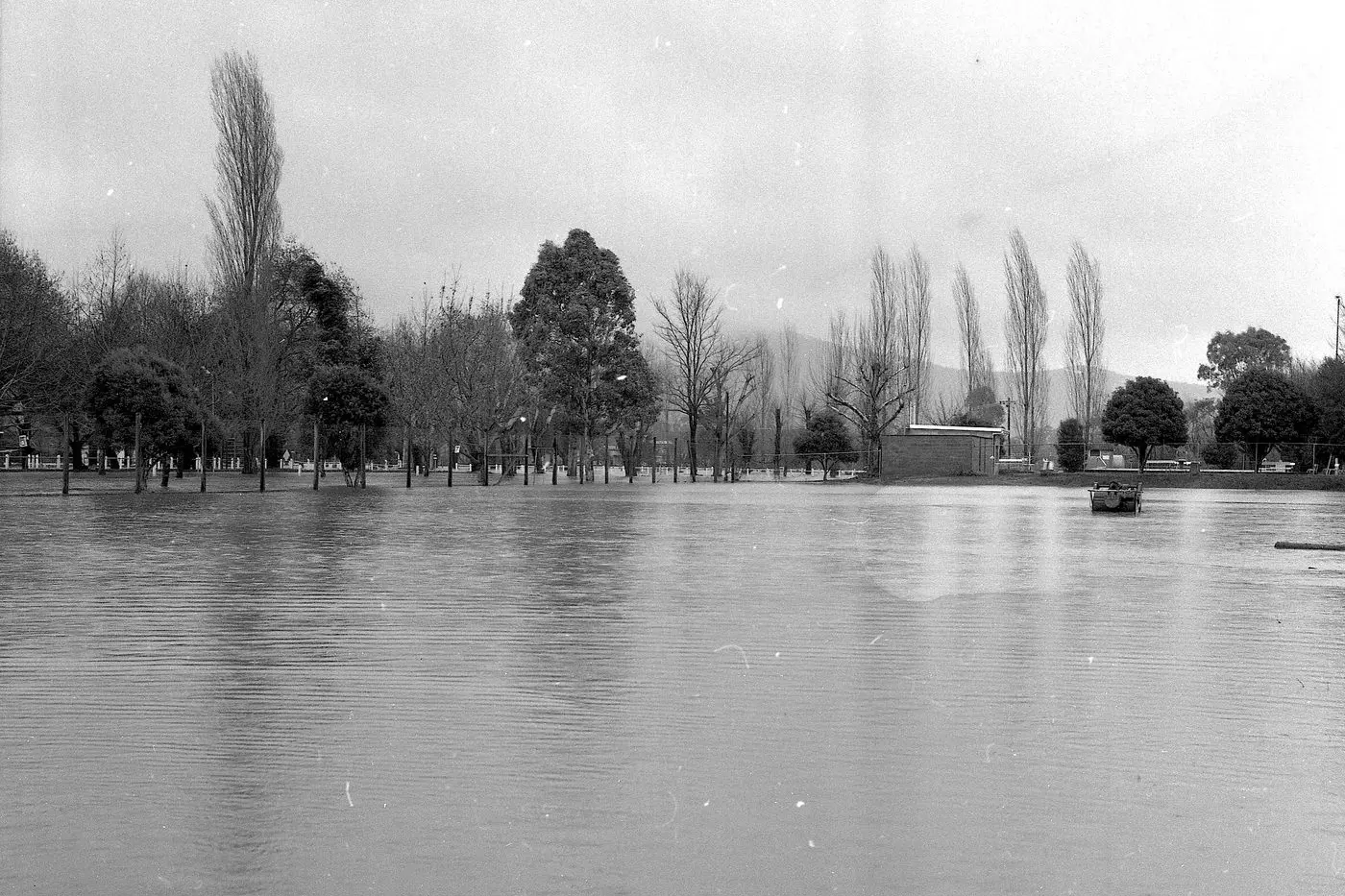
Over time, the area would experience regular flooding, witness gold dredging in the creek bed, be the venue for the Myrtleford's first swimming pool and an experimental crop of flax.
Known eventually as the 'Myrtleford Public Park', it became a significant place for local sports, fire brigade training and holiday accommodation.
One sport of note was tennis, which had been played in Myrtleford since the 1890s.
It had its origins on clay courts in the centre of town, one on Anglican Church property at the corner of Clyde and Standish Streets and another diagonally over the intersection opposite the Myrtleford Hotel on Smith Street.
In the 1920s a Saturday afternoon competition on clay centred on church teams and others from Gapsted, Eurobin and Whorouly East (Rocky Point).
Increasing interest led to two public courts of asphalt being built at Memorial Park.
Amenities were provided in a pavilion built in 1929 adjacent to the courts and oval.
From 1927, cement courts came into vogue, firstly next to St Andrew's Presbyterian Church in Smith Street, followed by a Methodist Church court opened on Albert Street by 1930 and the St Mary's Catholic Church court in 1935.
The Anglican Church's clay court was sold to developers of the retail precinct on Standish Street in the early 1930s.
Early in 1938, inspired by the reports of members attending a Kooyong tournament, it was decided to lay six public grass courts in the old "Police Paddocks".
Use of this side of the creek had commenced with the building of a swimming pool at the far end of the park in 1930.
The new grass courts were opened in 1939 and the Myrtleford Tennis Association went from strength to strength, as the number of teams in A and B grade revealed in 1940:
St Mary's (A and B), Presbyterian (A and B), Public Blue (A and B), Whorouly (A), Methodists (A and B), Public Red (A and B), Murmungee (B), Whorouly East (B), Whorouly North (A and B), Whorouly South (B), Bowmans (B), Eastern Stars (B), East Vale (B), Gapsted (B), Valley (B) and Anglicans (B).
Competition then went into recess during World War 2 as many male players were absent; ladies social tennis continued, affected by floods which had degraded the playing surface.
Appeals were made in 1946 for players to join court repair work crews and return to enjoy competition.
The 1946–47 season commenced with 24 teams in A, B and C grades.
In the early 1950s, three new grass courts were added, bringing the number of courts to nine.
Players and visitors were attracted to such an outstanding community venue for regular fixtures and tournaments.
The ladies mid–week competition and the annual Easter Tournament were attracting many players.
The Easter Tournament, which had humble beginnings in the 1930s rotating players to games at the church courts around the town, would register over 50 players by 1949 and would grow rapidly.
In the early 1960s senior teams were town–based and junior ranks were expanding.
No doubt, the visit of Jack Kramer's Professional Tennis Troupe to the lawn courts in mid–February, 1962 had much to do with this.
The 'Myrtleford Times' reported: "Over 500 spectators turned out to watch."
"The four players turned on a top–class brand of tennis never before seen at Myrtleford."
Some 42 juniors were attending coaching classes on Saturday morning in March 1963, as seniors approached the finals series.
The ladder at the time was: Methodists 34 points, Lawn 32, Presbyterian A 28, Presbyterian B 22, Church of England 16, St Mary's 8.
The tennis club joined the Ovens & King Association in 1966–67, with immediate success; attempts to recruit players were paying off and club membership had reached 90 by the end of the decade.
Heightened involvement at club level and success in 'Country Week' at Kooyong, floodwaters in May 1974 and an attempt to add more lawn courts in 1977 (without success) featured in the 1970s.
An alternative to extending the courts was taken up when asphalt surfaces at the football ground, to be shared with netballers, were offered by the Myrtleford Shire in 1979.
These hard courts would increase to six in 1980.
Flood waters would again envelop the old 'Police Paddocks' in 1981, creating need for a major clean–up.
It would not be the last, and by the end of 1982 a serious drought had struck, and the lawn courts would need water from nearby wells.
From humble beginnings on two clay courts, to concrete and asphalt and then expansion to nine lawn courts, tennis has created a fine chapter in Myrtleford's sporting and social history.