PHOTO
By JOHN TAYLOR OAM, Myrtleford and District Historical Society Inc
APART from occasional passenger trains of enthusiasts and special excursions, the Ovens Valley Railway after June 13, 1952, remained a freight line only.
It delivered all types of parcels, mail, machinery, all grades of fuel, fertilizer and shop supplies and carried out in return mail and parcels, timber, pulpwood, tobacco, fruit, cereal, butter, tobacco and livestock.
Branching off at the junction with the North East line at Bowser, the last 30 years of the line’s existence would see the quantity and composition of freight change, to be dominated by movements of fuel, timber, fertilizer and tobacco.
Over this same period, the line proved popular for steam enthusiast excursions.
In 1963 steam engines K161 and K162 hauled an enthusiast’s special of ten carriages on September 15, and on August 9 1969 K184 appeared at the head of another.
In October 1977, K153 arrived hauling five passenger carriages and finally in 1983 the Australian Railway Historical Society ran another K class tour to acknowledge Myrtleford’s railway centenary.
With water supply replenished, the tour’s return journey featured three photo shoots up the 1:40-grade Gapsted Bank.
The last steam-operated goods train, before the introduction of diesel-electric traction, was one which left Bright hauled by K176 on October 15, 1965.
These last trains had left Wangaratta at 6:15 am on Mondays and Wednesdays, arriving at Bright about 2pm or 3pm, then returning on the following day.
If required, a separate day return was run to Myrtleford only on Fridays.
When steam had finished in the North East, T class diesel T348 was the first to take over on the Ovens Valley branch.
Into the 1970s and 1980s it was tobacco, superphosphate and fuel deliveries which kept the line viable and Myrtleford railway station yards were the focal point for much of the traffic.
It was busiest during the tobacco curing and selling seasons but by 1978—79 improvements in road transport had brought intense competition from road hauliers.
Looking back, those towns serviced by the two branch lines beyond Everton had been closing down over a 30-year period.
The line to Yackandandah closed on July 1 1954 followed by the final goods train to Beechworth on December 28 1976.
A “last passenger train special” by the Association of Railway Enthusiasts was then held on January 3 1977.
The limiting of traffic movements to Bright commenced on April 6 1978 with the final scheduled goods train beyond Myrtleford and to Porepunkah only as required.
A special delivery of railway rolling stock to the Bright Museum followed in November 1981 and a shipment of superphosphate and one last carriage for the Museum was delivered on September 30 1982.
A delivery of agricultural lime to Porepunkah followed on April 6 1983, then on December 12 1983 the ‘Myrtleford Times’ headlined “MYRTLEFORD-BRIGHT LINE CLOSED: PERMANENT CLOSURE BEYOND MYRTLEFORD FROM NOVEMBER 30”: “Bowser to Myrtleford to remain in operation, but longer term future of this section would depend on market demand.”
In the meantime, the well-known ‘Tobacco Specials’ and fuel deliveries for Myrtleford continued.
Timber barriers were placed across the line between the Standish and Queen Street rail crossings.
In the railway station precinct, there was already no station building as it had previously been sold for removal to a farmer at Wooragee in 1971.
The last cattle train had left the Myrtleford livestock siding in 1977 before it was demolished.
This left the goods shed, which was advertised for sale in the “Myrtleford Times” in successive issues in 1982, but to no avail. It was demolished.
A freight centre in Wangaratta would eventually handle goods for Myrtleford from early 1984.
Since mid-1981 the Shire of Myrtleford had raised objections to the rail line closure on behalf of the local business community and agriculture.
In 1984-85 the Shire commenced actively seeking railway land, offering to liaise with the government as V/Line (as it was now called) considered its position on the future of the line.
V/Line continued to be non-committal about the land throughout 1986.
Then, one last train hauled a rake of 14 empty superphosphate trucks up the Gapsted Bank towards Bowser and Wangaratta in early December 1986.
In late March 1987 the branch line’s connection to the main N-E line was severed at Bowser “to avoid the need for construction of a flyover on the new section of the Hume freeway” and back in Myrtleford a barrier to the railway yards was erected at the Prince Street rail crossing.
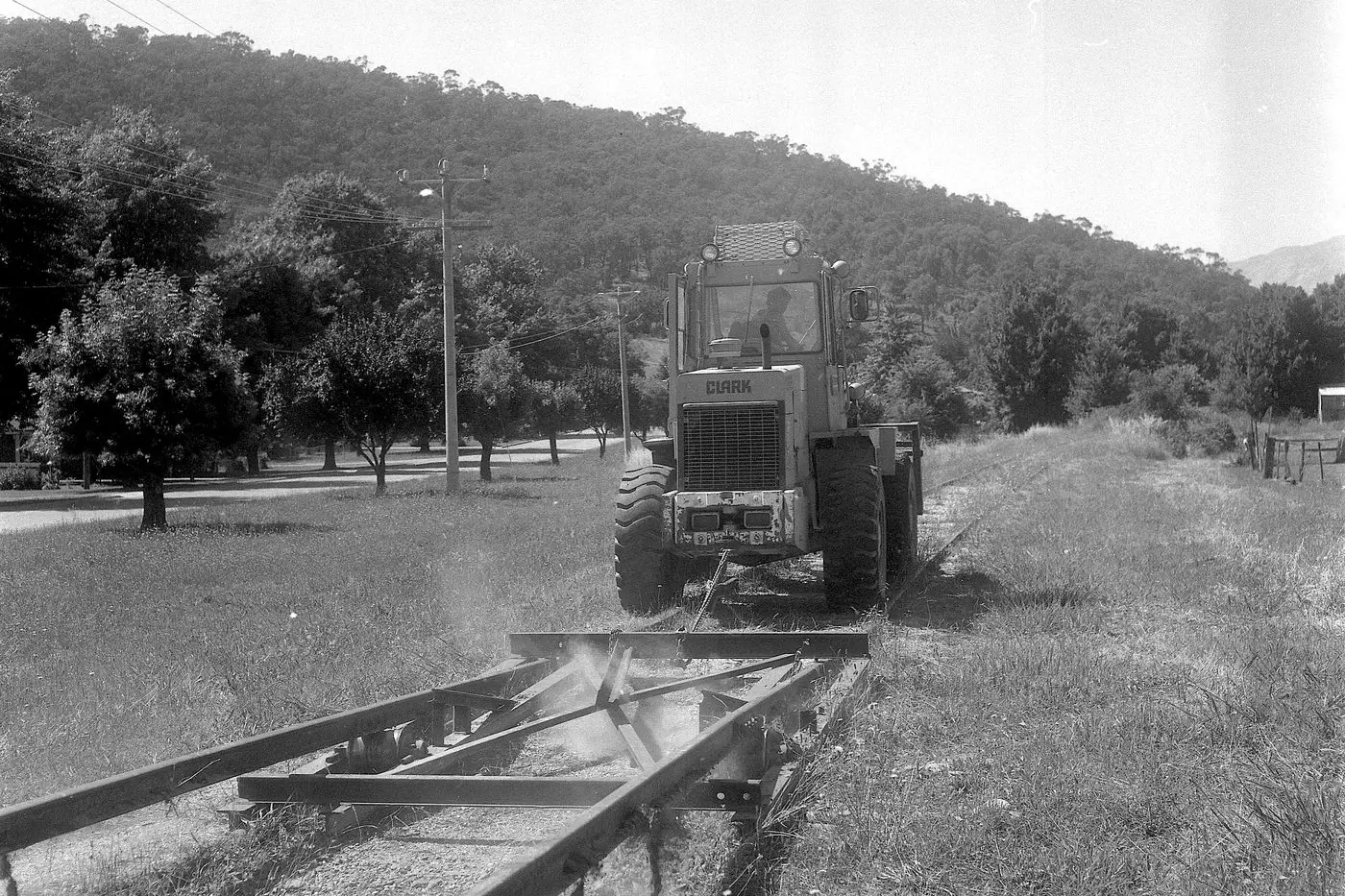
By December 1987 the signals at either end of the station precinct had disappeared and removal of the line’s steel rails and sleepers commenced through the town.
The Shire of Myrtleford was advised that “surplus railway land would not affect Myrtleford until the 1988-89 financial year.”
A tourist railway was briefly discussed in November 1987, but at ‘the end of the line’ the railway would become a rail trail.