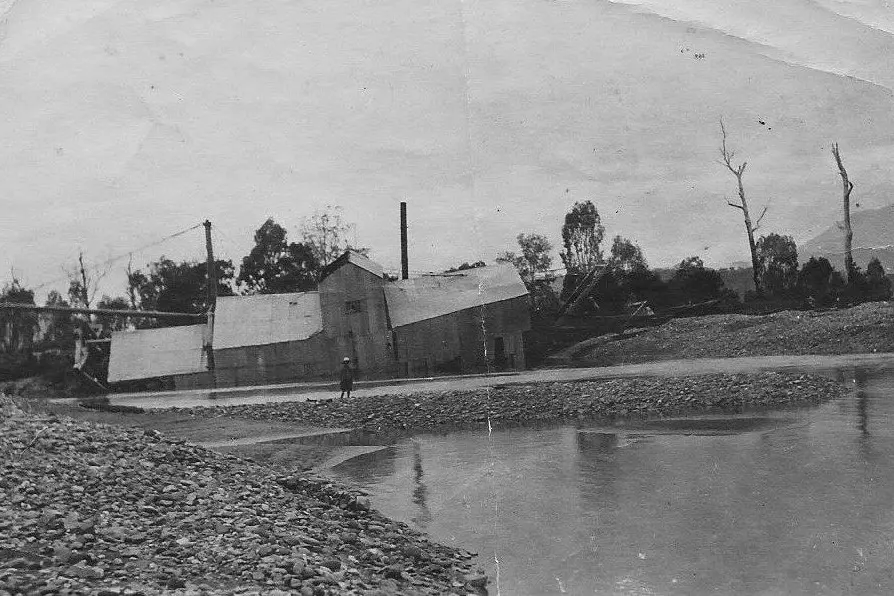
PHOTO
By JOHN TAYLOR OAM,
Myrtleford and District Historical Society Inc.
On December 29, 1898 the 'Australian Mining Standard' reported "although many individual gold miners and co–operative parties have for 40 years done well in alluvial mining along the Ovens and Buckland rivers, the days of this class of miner is slipping away."
Indeed it was, and increasingly local miners turned to various forms of farming or to trades and commercial activities in the Myrtleford district.
It was at this time, in 1900, that the first dredge appeared from New Zealand in the Ovens Valley, processing old auriferous (gold bearing) ground and digging deep below the old workings and nearby stream.
One dominant person involved was Pearson W. Tewksbury, who from 1901 would operate 11 dredges, working on leased ground mainly on the Ovens River.
His success attracted the interest of other investors and mining workers.
Dredge work crews could be at least 15 men, in three shifts of five each: the dredge master, engine driver, winch man, boat man (to ferry firewood for the boiler) and box boy (to keep the sluice races uncongested on board).
From Porepunkah, dredging spread downstream to above Eurobin where rich agricultural river flats and the stream bed were destroyed.
Eventually the impact on this rich black loam, from Harrietville to Eurobin, would have long term consequences.
In the Myrtleford district the impact of dredging was less evident, but some evidence remains at the river junction of the Ovens and Buffalo Rivers and the lower reaches of Barwidgee Creek.
The 'Reform Dredging Co.' (1911—1917) had a 5–year lease on the bed of the Happy Valley Creek through the centre of town from the swing bridge on Standish Street to the Victoria Bridge, and in 1913 to the Reform Mine Battery site further up the creek.
On November26, 1914 the 'Myrtleford Times and Whorouly Witness' reported that "operations have virtually ceased......buildings, machinery, etc. which cost some thousands of pounds have been dismantled....the stoppage of these works will be severely felt by business people and people employed therewith".
"Mr. J.A Wilson has now established a chilling works for fruit, etc. at Hurstbridge."
The dredge remnants, floating in the creek, were eventually swept away by the 1917 flood.
The 'Barwidgee Bucket Dredging Co.' (1907—1912) commenced work in the formerly named Myrtle Creek north of the highway.
Upstream, behind the home of the Tom Collins' family, it negotiated a rock bar by damming the creek and floated over, continuing on to Waterloo behind the Toner farm.
The 'Myrtleford Dredging Syndicate' (1906—1920), locally owned and managed by the Cameron brothers, was the most successful of the local dredging operations on its leasehold of 82 acres over an extended lifetime.
The 'Myrtle Queen Dredging Co.' (1904—1913) operated from beyond the junction of the Ovens and Buffalo Rivers, 3 km from Myrtleford.
One km upstream, a submerged red gum log sank the dredge, but machinery was salvaged before it was blown up to clear the waterway.
The 'Ovens Junction Bucket Dredging Co.' (1907—1913) commenced at the confluence of the Barwidgee Creek and the Ovens River and worked upstream until it reached a rock bar above Nimmo Bridge and settled there.
Timber and iron were salvaged, and the dredge's boiler was removed to the Myrtleford Butter Factory.
Remnants remain buried in the sand and gravel beneath the water today.
The 'Running Creek Dredging Co.' (1907—1908) operated a small dredge at Havilah for two years.
News of the impact of dredging elsewhere and the fear of sustained activity near the town led to the Myrtleford Progress Association calling a meeting of farmers and businesspeople to address the issue in 1907.
As a result, the 'Ovens Valley Farmers' Land Protection League' was formed to address the issue.
Thirty–six prominent locals, from Eurobin to Whorouly, joined a total of 50 concerned citizens as members of the league.
Families represented included Mullholland, Panlook, Walkear, Mummery, Duane, O'Sullivan, McCormack, Clemens, Croucher, McFadyen, Munro, Ferguson, McIlroy, Rae and Wallace.
Other consequences of dredging arose due to obstruction of stream flow by silting up and when dredge tailings destroyed nearby vegetation.
As a result, the 'Ovens River Anti–Sludge Pollution Association' was formed in Wangaratta with the objective of ending dredging.
Signatures of landholders from Harrietville to Wangaratta were collected in a petition, including locals from Gapsted, Whorouly, Murmungee, Bowmans and Everton, backed up by Wangaratta Waterworks Trust collecting signatures of ratepayers. These were submitted to the Minister of Mines, seeking his support, in 1911.
Evidence also existed that some of the 40 dredges in the Ovens Valley were not rehabilitating land on their leases, thus breaching Clause 36 of the Mines department's 'Resoiling Covenant'.
In 1912, the interest of investors was beginning to wane.
Leases continued to be relinquished into the 1920s and successful local community opposition to dredging would remain until the late 1930s.
In December 1930 locals were alerted to a proposal to dredge from Wobonga to the Nimmo Bridge and then in 1936 another application was made to dredge land "within one mile of the Eurobin Post Office".
The 'Myrtleford Times' in 1937 alerted readers to a second application to dredge downstream to the Nimmo Bridge followed by another to excavate from that bridge to Rocky Point, resulting in a successful petition "to avoid the possibility of useless ground fit only for blackberries, St John wort and rabbits."
After 1939, any possible dredging was to occur upstream of Eurobin and the largest dredge would be the 'Tronoh' at Harrietville, from 1941 to its dismantlement in 1956.