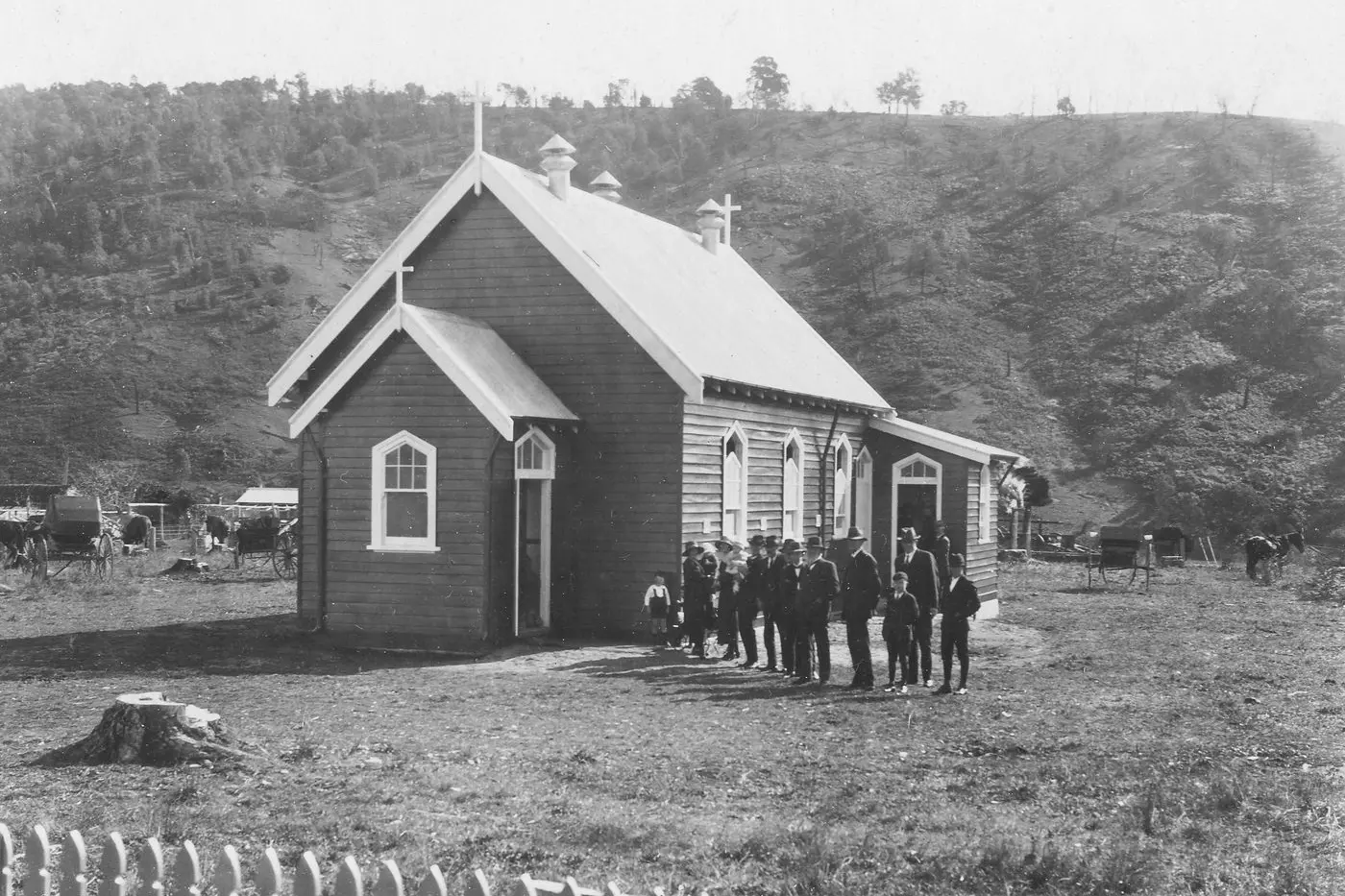
PHOTO
By JOHN TAYLOR OAM, Myrtleford and District Historical Society Inc.
THE arrival of people of English, Scottish and Irish descent in the Ovens Valley from the 1850s eventually led to the need to congregate and share religious beliefs.
Cornish gold miners erected a Wesleyan Chapel on the main roadway through Myrtleford in 1855.
It was of slab wall timber construction with shingle roof and attracted support from many Protestants.
Within 30 years, it would be replaced by a weatherboard Methodist Church opened on October 25, 1885 on the same site.
In 1957–58, it was relocated back off the main thoroughfare to make way for the construction of a brick church dedicated on May 8, 1958.
An original Roman Catholic Church was erected in 1860, again of timber slab and shingle construction, between the Wesleyan Chapel and where the railway to Bright would be laid from 1884.
It was known as St Thomas Myrtleford.
The limitations of this Albert Street site led to acquisition of land between Lawrence and Prince Streets.
This decision, under the leadership of Messrs O'Donnell and Carley, led to the opening of a new brick church, known as St Mary's on May 6, 1888.
Beyond its centenary, a new church next to the old St Mary's would be consecrated in 2002.
In 1868 the first Anglican Church in the district was dedicated at Running Creek (Havilah) where, at one stage, a village population of 2000 was served.
A rapid decline in population in the early 20th century saw the small timber St John's Church demolished on November 3, 1921.
Plans had been made to relocate the church to Happy Valley, but this did not eventuate because the building was beyond repair.
A timber St Paul's Anglican Church in Myrtleford was dedicated on November 10, 1872.
After 50 years of service, the church was relocated further back from Clyde Street and a new brick church was erected, then dedicated on December 21, 1932.
Louis Williams was the architect.
The old church was demolished in 1965 to enable a new brick hall to be erected.
When Thomas Robertson had completed building the iconic two–storey Myrtleford Hotel, he went on to assist building St Mary's Church and St Andrew's Presbyterian Church in Smith Street.
St Andrew's was opened on May 19, 1889.
Thomas Robertson had supplied the bricks to be laid by a Mr Sandham.
Prior to 1889, Presbyterian services were held in the Anglican Church.
A Sunday School Hall was opened in 1954.
Services concluded at St Andrew's on August 4, 1991.
At Mudgegonga, the Catholic community gathered at their original weatherboard building from November 12, 1882.
It had rudimentary facilities which gradually improved and long–term fundraising eventually saw a new St John's Church opened on May 25, 1924.
Out at Eurobin, on the highway, St Clement's Anglican Church was dedicated on March 11, 1910.
It attracted support from local farming families and those who had attended church at Havilah after it closed.
After 60 years, St Clement's also closed. This old weatherboard building still stands today.
In the Whorouly district, three congregations were formed.
A land grant enabled the Catholic congregation, predominantly of Irish descent, to meet in a slab timber school building from 1869.
The state of the building eventually led to a call for generous support to finance a permanent brick structure.
Strong support was forthcoming, and St Patrick's, designed by architects Kempson and Conolly, opened in late October, 1896.
The first Anglican service was held at Whorouly in 1870, in a shed on the property of Mr Lot Barker until 1873.
Agreement was reached to secure land in the Town Reserve and active fundraising led to a timber Church of St John being opened on November 9, 1873.
Due to destruction by white ants, a second brick church was then constructed and dedicated on December 14, 1902.
Methodists at Whorouly and Whorouly South began meeting at the local school and scout hall from 1920, then Whorouly Hall, before centering all services at Whorouly South in 1959.
Within two years, a brick church would be built on Whorouly Road, opening on December 18, 1960.
As a Uniting Church, it closed after 50 years of service.
Other small church groups have assembled in the district over time: at Buffalo River Hall in Moore's paddock, at Buffalo River South in the old school building, at Murmungee in the old hall on Buckland Road and at Gapsted, in a Union Church building near the Post Office.
All these places have proved to be important in developing a sense of community and belonging for successive generations.