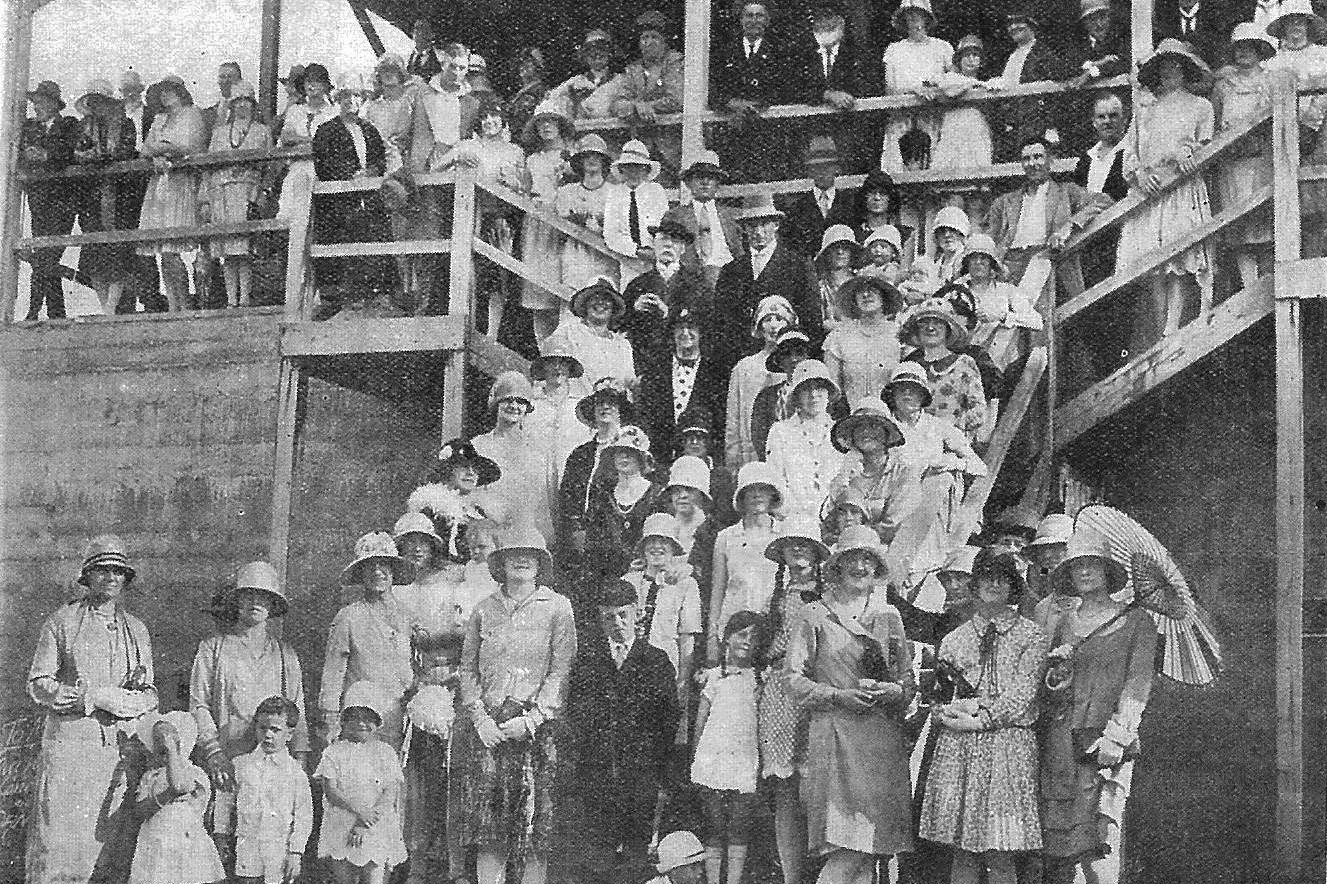
PHOTO
By JOHN TAYLOR OAM, Myrtleford and District Historical Society Inc.
THE first horses to graze in the Myrtleford district came in 1837 with the arrival of European overlanders, led by John Hillas, driving 1,300 head of cattle on to the Myrtle Creek Pastoral Run.
Local indigenous people already knew of horses, having observed the Hume and Hovell exploration party descend the ranges in 1824 and follow the Burgoigee Creek to its junction with what they would name the Ovens River.
Growth in population after 1850, associated with gold mining, grazing, cropping and commerce created a need for communal gatherings.
One such activity was competitive horse racing where the skill and prowess of the rider and endurance of the horse could be displayed.
To provide stock for racing, some local thoroughbred owners rode or walked their stallions around the district, including John Carroll of 'The Laurels', Mudgegonga with 'Blue Peter', Lott Healy from Tunnel Gap Road, who had 30 farmers in his stock book, and JE Milne who kept detailed records of the progeny of his 'Macedon Mount'.
Myrtleford's first organised horse racing event was on a flat course in the centre of town in April 1867, where the Co–Store, Myrtleford Hotel and railway station yards were eventually located. The start and finishing posts were outside the Myrtle Creek Hotel, established by Joseph Paul in 1857.
Later, it would be known as the Temperance Hotel and then the Golden Valley Cafe.
Nearby, a second racecourse was established on Merriang Pastoral Run on the side of the round hill where a flax mill would be established in 1942.
On October 2 1866 the Myrtleford Racing Club (MRC) was formed by nine prominent pastoralists and businessmen and in November four members of the committee, Edward Chambers, John B May, John O'Brien and Peter B Wallace, were appointed to petition local parliamentarian Mr GV Smith MLA to defer the sale of Crown Land lots along the Barwidgee (then known as the Myrtle) Creek with the intent of developing a racecourse and recreation precinct.
The committee's petition was successful and a contract to fence in the land was signed off in April 1868.
In March 1869 the new track was in order for racing and the trustees erected a grandstand in 1869.
It was condemned as unsafe in 1885 and replacement was built by Mr F Farley in November 1896.
Many well–bred highly regarded horses appeared at the races.
Events at the old town racecourse in 1867–68 were two–day events, with four races on the flat each day with names such as 'Maiden Plate', 'Publican's Purse', 'Miner's Purse', 'Consolation Stakes' and 'Ladies' Purse'.
Hurdles and hack events were also held.
Horses, such as 'Misty Morn', 'Ray's Lottery', 'Mountain Maid', 'Little John', 'Wee Mick' and 'Smuggler' sometimes appeared in two races on any day, up to two miles in length.
The first event on the new course saw many of the old favourites return, attracted by record prize money of 165 pounds.
They were joined by 'Spanker', 'Shylock', 'Rose of Australia', 'Eaglehawk' and 'Pathfinder'.
In 1874 the two–day event was abandoned for one day of six events.
New horses and owners continued to attend.
In 1881, local owners Messrs E Chambers, T Barton, C Gerraty and J McHenry were prominent.
Due to the economic impact of the closure of Reform Mine in 1888, no meetings were held in 1890 or 91.
This led to the creation of an amateur racing club which eventually amalgamated with the MRC in 1892.
The annual meeting of the club on November 12 1898 saw a committee of 17 members elected under the leadership of Mr J Hart (President), D Niall (Treasurer) and R Milne (Secretary). Other members included M Carley, A Croucher, C Teakel and G Murray.
Success continued into the new century for the MRC, but it became clear that a Recreation Reserve Committee was needed to control overall use of the area and set charges to cover maintenance costs.
This committee first met in April 1908.
Early challenges related to the need to support the racing calendar, responding to requests for access to dredge and mine for gold, the need for a reliable water supply, responding to a request from the Light Horse Militia to conduct drills and a suggestion to establish a rifle range on the site.
Horse racing continued, and at an unregistered meeting on Boxing Day, 1911, the 'Myrtleford Mail & Whorouly Witness' reported "The attendance was about 800.....The pretty little course looked well after recent rains, and the going was good, with the exception of one or two small crab–holes".
"Visitors came from all parts, from Wandiligong to Stanley.....the afternoon's sport was the best seen here for years."
The Recreation Reserve Committee abandoned meetings during World War I, until 1919, when rules based on Department of Crown Lands and Survey regulations were reinforced, and controls introduced over any improvements.
The Reserve became a major venue for sports and gala days to raise funds for the War Memorial.
During 1924–26 major issues related to grazing licences and stray stock, pest and weed control and improved road access.
The late 1920s and early 1930s saw renewed controversy on subletting charges and discussions on leasing and course design with the fledgling golf club.
The MRC's regular race meetings, in affiliation with the North–Eastern Unregistered Racing Association and Yackandandah Picnic Racing Association, would continue until its last events in the late 1930s.
By 1943, during World War II, the Reserve Committee turned its attention to grazing rights for cattle penned by auctioneers, sports days to support the RSL and further plans for expansion of golf club amenities.
In 1947 an agricultural show was trialled by the community, led by AW Richardson, EMG Dean and HJ Ashdown, with a view to commence a permanent annual event in 1948.
Beyond 1950, a community asset continued to evolve from the humble beginnings of 1869, to offer facilities we can enjoy today: a golf course, indoor sports facilities, horse events, an agricultural show and a speedway.