PHOTO
By JOHN TAYLOR OAM, Myrtleford and District Historical Society Inc.
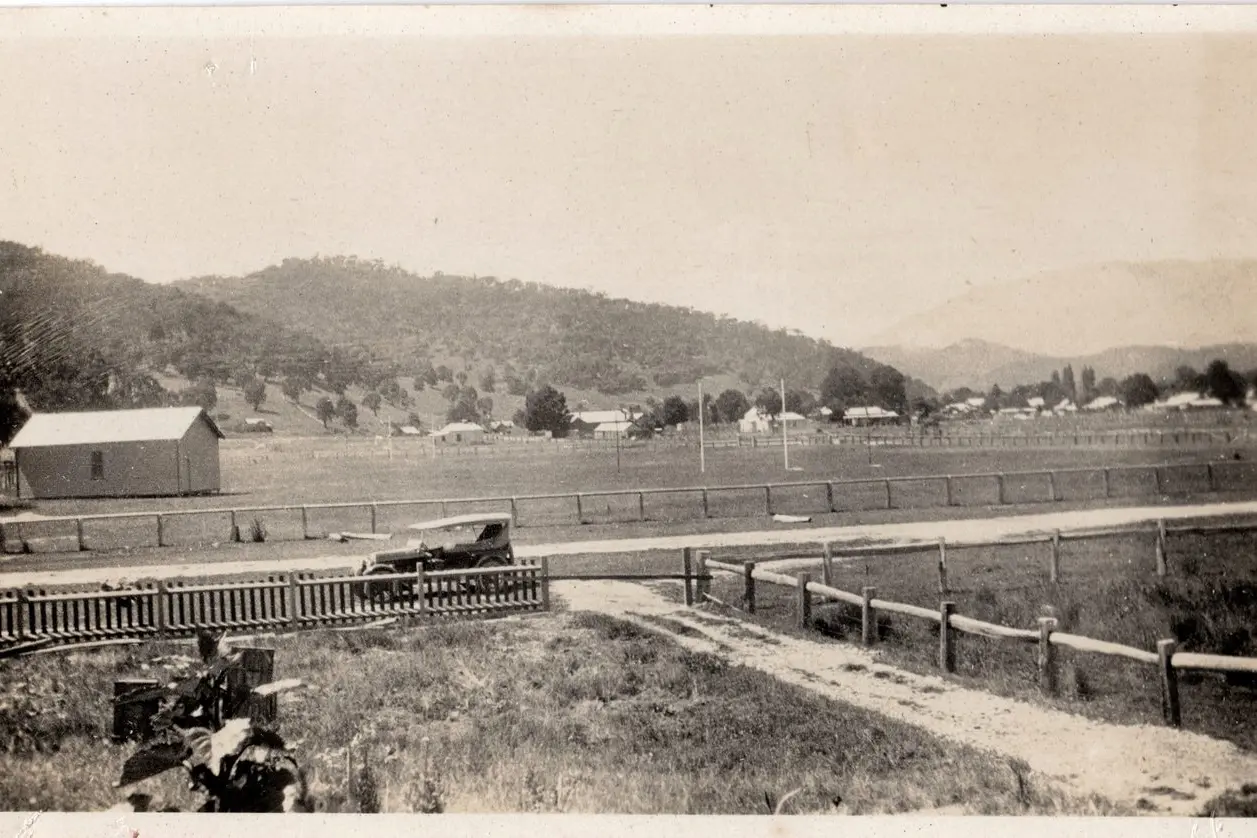
SINCE the late 19th century, the area that would become bounded by Lawrence, Duke and Prince Streets has seen a variety of recreational activities—horse racing, footraces, cricket, football, gymnastics, wood chops, tennis and festivals, to name a few.
What came to be named ‘Memorial Park’ has an interesting history.
The land was originally owned by the Haxton family who had participated in early sales of allotments following the official naming of the town in 1858.
They gave permission to use this open space for cricket and football matches from the 1890s.
Miss Haxton left the district for northern New South Wales, having married the Rev. Chambers and in 1920 a committee of prominent local businessmen sought to purchase the land by public subscription. This committee consisted of T W Williams, N Smith, J B Robertson, H F Lowerson, R D McGeehan and J Smith.
The committee approached Mrs Chambers, who agreed to sell on the proviso that the land be reserved solely for public use.
A deposit of ten pounds was paid, supplemented by public subscription of the balance.
Myrtleford’s first public sportsground had come into being.
During 1921-23 work began on fencing the ground, with Mr Frank Dwyer being the successful tenderer for the job.
Red gum posts and angled railing, wire netting and entry gates at the Duke and Prince Street corner were erected.
At the other end of the ground, a section of picket fencing and double gates was installed at the corner of Lawrence and Duke Streets.
On the 50th wedding anniversary of Thomas and Sarah Williams in 1933, two elm trees were planted at this old entrance, acknowledging Thomas’ involvement in the early effort to acquire the ground.
Fifty years later, two plaques were placed at the base of these trees by their descendants.
In 1926, a sports pavilion was constructed by Mr R D McGeehan at a cost of 200 pounds, funded by the public fund raising of a Memorial Reserve Ladies’ Committee.
A major source of funds were dances held at the Rechabite Hall in Elgin Street.
The pavilion was officially opened by Cr John Smith, president of Bright Shire, cutting a ribbon.
The need for this pavilion had been evident to many for some time.
It provided catering space for afternoon tea at the tennis and cricket and changing rooms for footballers.
Until then, footballers would change in a booked room or the stables at the rear of the Railway Hotel and then run up Duke Street to play.
Others had been changing in covered wagons or cars at the ground.
The pavilion formed a backdrop to team photos taken on game days and would eventually be removed to become a farm storage shed in the mid-1950s.
In the early 1950s, moves also began to shift the football club’s activities to land on Lewis Avenue.
This occurred in 1954, but cricket, minor league football fixtures, tennis and eventually soccer would continue to be played at Memorial Park.
In April, 1954 it was the major outdoor venue at which Myrtleford celebrated its centenary, under the leadership of a committee of 12 led by Ernie Shears.
All district schools participated in a District Sports Day, then followed displays and celebrations over the weekend.
Under the headline “Myrtleford Centenary Celebrations Made Happy Folk”, the ‘Weekly Times’ reported a record crowd at Memorial Park in its issue on May 5, 1954 including members of the Long and Howells families of Duke Street, the O’Callaghan’s of Mudgegonga, the Wood family of Rosewhite, the O’May’s and Panlooks from Eurobin, the Petzke’s from Dandongadale and the Moore’s of Buffalo River.
Today, driving along Duke Street, this public asset continues to be a picturesque hub for sports, particularly for juniors, and many memorable scenes can be recalled of a diverse array of past events.