PHOTO
By JOHN TAYLOR OAM, Myrtleford and District Historical Society Inc.
THE arrival of 'moving pictures' in Myrtleford just prior to the outbreak of World War 1 created great interest.
For 50 years, people had been amusing themselves through concerts and balls and inviting travelling show people to town with circuses, magic displays, dances and song.
One of the first films screened in Myrtleford was in 1912, at Moore's Hall (next to the Railway Hotel).
It was part of a larger format, a vaudeville show, with live acts at the top of the bill.
The film was silent, screened on a calico sheet to the amazement of the packed audience.
Several travelling showmen began coming to Myrtleford with their moving pictures, with screenings three times a week by the early 1920s; these included Parkinson's Pictures from Beechworth, Maguire's of Wodonga and William Hill's Electric Pictures.
Of particular note was Will Hill, who employed youth of the town as bellringers to announce his evening program and venue and, if required, hand–wind the projector at a constant speed.
A back wheel on Will Hill's vehicle would drive a conveyor belt attached to an electric generator for lighting.
They set up elementary projection equipment at five venues.
There were four halls available: the Athenaeum Hall (near H F Lowerson's Store), the Rechabite Hall on Elgin Street, Robertson's Hall (next to the Myrtleford Hotel) and Moore's Hall.
In fine weather, Milne's Open Air Theatre could be hired at the corner of Clyde and Queen Streets (the site of a supermarket today).
The newly erected Soldier's Memorial Hall became the venue for movie–goers from late 1925 and several showmen hired it for screenings.
During its first ten years, the hall was a busy place with balls, concerts, public meetings and movies.
In the 1930s the Memorial Hall Committee leased the hall exclusively to Mr Bill Jennings who, in association with Eric Belcher, would remain the registered exhibitor for 20 years.
Bill Jennings was a natural showman and had travelled the movies circuit in North East Victoria.
Locally, he was also known as a rabbit merchant and he successfully trained several race horses.
The pictures were advertised as 'The Talkies' in the pages of the 'Myrtleford Times', with three evening shows and a Saturday matinee each week.
In 1952 lease of the hall was reviewed and Mr Jack Scott of Cobram was the successful tenderer.
He retained the services of Bill Jennings as theatre manager and projectionist.
Jack Scott's stay was short lived, and he sold the show to Mr Pasquale (Paddy) DeFazio, who owned a business opposite the hall, in 1954.
Paddy obtained permission for a 'cinema club' to begin screening Italian language films on Sunday nights in 1954 and in late 1961 he opened a second picture theatre (the New Myrtleford Theatre) next to his Golden Leaf Cafe and service station, on the belief of an expanding movie attendance.
Bill Jennings, with the assistance of Tiff Rayner, continued in his old role of manager and projectionist.
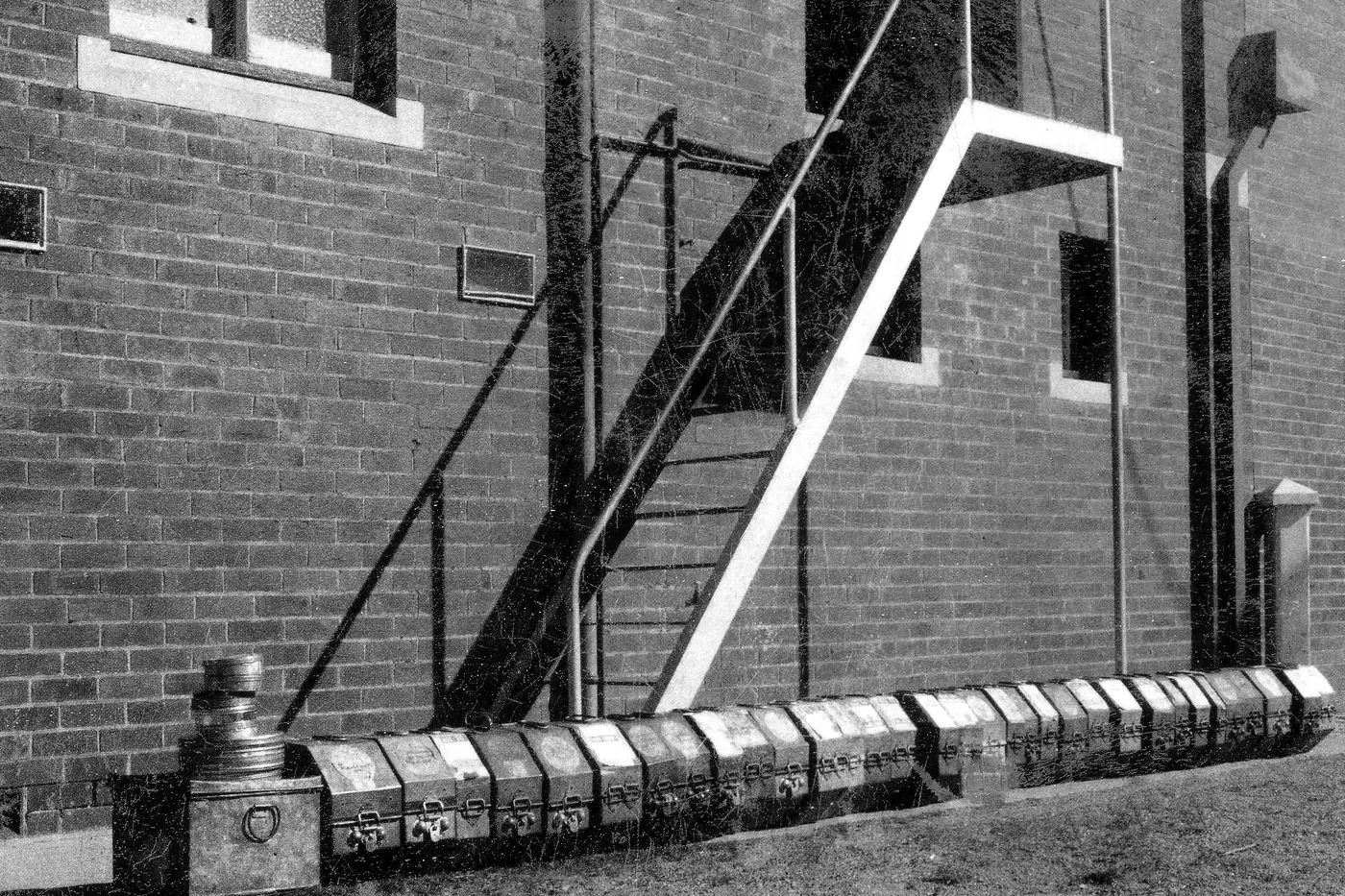
Italian language movies were shown at both halls and popular movies shown in English language at Memorial Hall would be conveyed by wheelbarrow to the new venue where they would be rescreened with Italian dialogue and English subtitles.
Full houses to view 'The Ten Commandments', 'Ben Hur', 'Doctor Zhivago', 'Franco & Chico' or 'Toto the Clown' was not unusual.
The illness of Bill Jennings led to the temporary appointment of Ray Burns as projectionist until Tiff Rayner acquired his licence in 1963 at which point he took over running shows and booking films and collecting them from Melbourne for both of DeFazio's venues.
Local cinema was prospering, enabling three changes of program a week and Italian language films on Sunday evening.
Matinees, featuring a serial and cartoons, were popular with children from the 1950s until the mid–70s.
Change was, however, underway.
GMV 6 and ABV 3 began transmitting television pictures into the Ovens Valley in 1962–63.
TV picture quality was patchy using high antennas.
In November 1965 Pasquale DeFazio sold his leasehold at the Memorial Hall to Tiff Rayner, and a renewal of the hall frontage and foyer in 1967 followed.
All shows were screened at DeFazio's hall for five months during these renovations, before screenings ceased there altogether.
A refurbished 'Myrtleford Theatre' returned with new equipment, furnishings and sound system prior to 1970, which attracted patrons seeking blockbuster movies of the time.
However, during the next 20 years, the impact of colour television, videos and the erection of alternative venues for community events reduced attendance and use of Memorial Hall.
This was very discernible from the mid–1980s when shows were held only for two nights per week, and in 1992 'The Big MT' ceased screening regular features after 67 years of entertaining local people.