PHOTO
By JOHN TAYLOR OAM, Myrtleford and District Historical Society Inc.
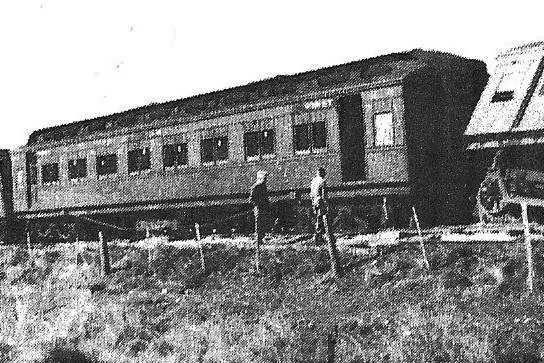
THE morning train from Bright to Wangaratta left the Myrtleford Railway Station on May 16, 1952 with no reason to suspect what would lie ahead on a bend beyond the Barwidgee Creek railway bridge one mile from town.
The accumulated lack of wartime maintenance and a shortage of material, which stretched into the 1950s, caused speed restrictions of 25 mph on the line, down from 40 pre-war.
This did not prevent two passenger carriages from being derailed, one precariously, on this day in 1952.
“MIXED TRAIN LEAVES RAILS” headlined the ‘Myrtleford Times’ on May 21.
The D3 635 steam engine had rolled a rail over, and 60 passengers, several on their return journey from Mount Buffalo Chalet, climbed out on to the track and were promptly conveyed to Wangaratta by McPherson’s Bus Lines.
A crane and lifting gear brought from Newport and Benalla righted the carriages and the track was repaired, but the curtailment of a regular passenger rail service was now on notice.
And so a decision was made and announced in the local newspaper on April 23: “PASSENGER TRAINS OFF—POSSIBLE DEATH KNELL”: “On June 13, 1952 the last train to regularly carry passengers will leave the platform at Myrtleford.”
It would be just one year short of 70 years of service to the town and a regular road service to cater for the Mount Buffalo tourist trade would replace the passenger train.
The last passengers on the regular ‘mixed train’ on June 13 were in a carriage attached behind seven goods wagons and a K 164 steam engine.
One passenger had come from Bright (Mr Wal Larsen, railway enthusiast and historian) who met up with 12 local people on their last trip towards Wangaratta.
Patronage on the Ovens Valley Railway had been declining for some time in the early 1950s as motor vehicles became more common on roads and a bus to Wangaratta had begun connecting with the north-east line’s afternoon service to Albury and taking patrons to the service to Melbourne earlier in the day.
In addition to all this, there was the slow journey to and from Wangaratta on the old ‘mixed’ service, which could take three to five hours between Bright and Wangaratta, and the Victorian Railways Commissioners had already begun closing passenger services on several branch lines across the state.
On hearing of the news of the passenger rail closure, locals became anxious about the regular mail service which arrived by rail.
On June 3, 1952 the ‘Myrtleford Times’ headlined “SOLVING THE NO-TRAIN PROBLEM, ESSENTIAL SERVICES—PER ROAD”, reporting on a meeting in Bright attended by representatives of the Myrtleford Progress Association.
Association president Mr E Shears stated “the district was anxious regarding its mail and newspaper service…..the road service for passengers seems entirely satisfactory”.
A regular receipt of these services and the opportunity to have urgent mail replied to on the same day was also emphasized by Mr T Robertson.
Reinstatement of a rail passenger service using a diesel rail car was also raised by Bright representatives, and the Hon Ivan Swinburne MLC undertook to take this up with the Victorian Railways.
This request was knocked back due to the state of the line.
The following week, “NEW POSTAL ARRANGEMENTS” were announced for local mail: Leave Wangaratta daily 9.00 am, Myrtleford 10.15 am, Bright 11.15 am. Leave Bright 11.30 am, Myrtleford 12.30 pm, Wangaratta 1.45 pm, with delivery and collection also at places in between.
The quiet demise of the passenger service was in great contrast to the arrival of the first train in Myrtleford on December 13, 1883 with all the fanfare, speeches and a ball in the Athenaeum Hall.
However, the official end to the regular passenger service did not mean passengers would never arrive and leave the Ovens Valley on rail again.
There were many examples of special rail ‘excursions’.
One occasion occurred on March 5, 1954 when 600 school pupils and adults travelled by passenger train to Benalla to see HM Queen Elizabeth II and HRH Prince Phillip.
The rail excursion was co-ordinated by Mr P R (Bob) O’Brien, head master of the Myrtleford Consolidated School and arrived at Benalla at 10.00 am to view a Royal Visit which lasted 30 minutes.
The ‘Myrtleford Times’ reported on a “most memorable experience for residents of the North-East”, with an estimated 1500 district locals venturing to Benalla.
Special mention was made of Mrs J Matthews, who had decorated the Myrtleford engine conveying the schools excursion.
Another occasion occurred in November, 1956 when a tour group attended the Olympic Games in Melbourne.
Then, several rail enthusiast specials in the 1960s, 70s and early 80s would bring passengers back to the Ovens Valley to experience the leisurely trip old travellers once enjoyed.